Healthcare video marketing examples demonstrate how providers are successfully connecting with patients in today's digital-first world. Here are the top categories you'll find most effective:
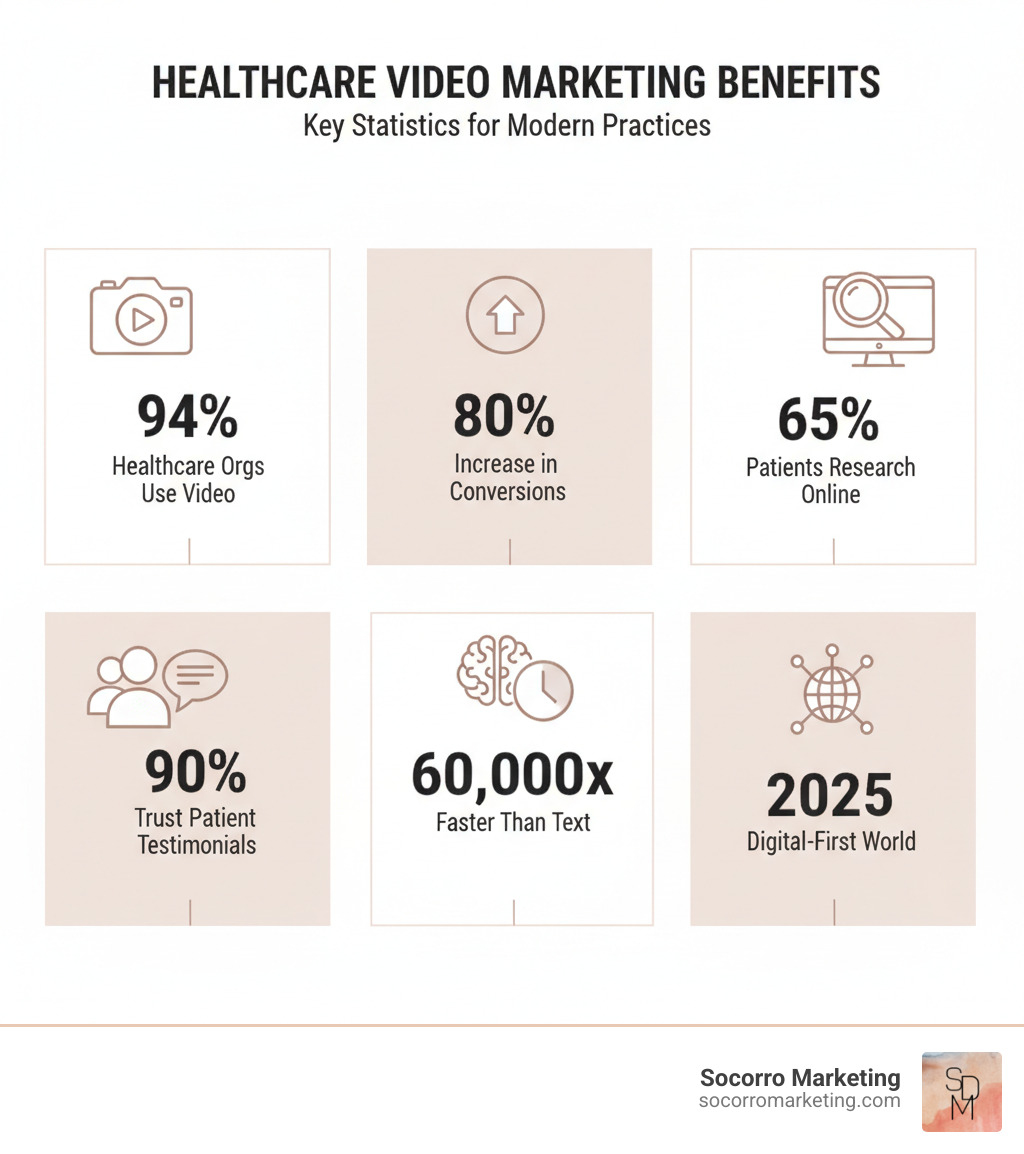
With 65% of patients researching online before choosing a provider, it's no surprise that a reported 94% of healthcare organizations use video marketing. Video meets patients where they are—scrolling on their phones, researching symptoms, or comparing providers before making an appointment.
The data is compelling. Adding video to your website can increase conversions by up to 80% because the human brain processes visual content 60,000 times faster than text. In a world of 8-second attention spans, video cuts through the noise far more effectively than brochures or blog posts.
Most importantly, video builds the trust required for healthcare decisions. Research shows that 90% of people trust patient reviews more than a practice's own claims. This is why testimonials, procedure walkthroughs, and authentic staff introductions are so powerful—they showcase real people, real outcomes, and real care.
I'm Grace Ascione, a registered nurse with an MBA and over 15 years of experience helping small healthcare businesses strengthen their digital presence. Throughout my career, I've seen how the right healthcare video marketing examples can transform a practice's ability to connect with patients and communicate complex medical information in ways that written content simply can't match.
Healthcare can be intimidating, with its complex terms and procedures causing patient anxiety. Video is the perfect tool to overcome this.
Video builds patient trust in ways text cannot. When potential patients see your team's smiles, tour your facility virtually, or hear a patient's recovery story, something powerful happens. You're no longer just a name on Google—you're real people who care. In healthcare, trust is everything.
Because our brains process video 60,000 times faster than text, your message lands with immediate impact. The emotional connection from watching a doctor explain a procedure with warmth is something a pamphlet can never replicate.
One of video's greatest superpowers is simplifying complex medical topics. Imagine explaining a colonoscopy with words versus showing it with clear visuals and friendly narration. Animation can make what felt scary become manageable. Patients arrive at appointments informed, confident, and less anxious, which directly improves their entire patient experience.
For practice growth, video is a powerhouse. Adding video to your website can boost conversions by up to 80%. When potential patients see a welcome video or testimonial, they are far more likely to book an appointment. It's a proven strategy, with studies showing 93% of marketers gain new customers through video and 92% report a positive ROI.
Video also strengthens your brand authority and deepens community engagement. Sharing educational content about preventive care or local health initiatives positions your practice as a trusted community leader. This is especially valuable for small practices in competitive markets like Golden, Colorado, Utah, Arizona, and New Mexico.
Finally, video creates the crucial emotional connection that turns viewers into loyal patients. A heartfelt testimonial or a behind-the-scenes look at your team's camaraderie touches people in ways that bullet points never will.
The healthcare advertising market is expected to hit $44.56 billion in 2025, meaning competition is fierce. Video helps you cut through the noise while remaining personal, trustworthy, and genuinely helpful. To understand how video fits into your broader content strategy, check out our guide on How Content Marketing Can Benefit Your Small Business Healthcare Facility.
Whether you're looking at healthcare video marketing examples from major hospitals or considering your first patient testimonial, remember this: video isn't just about trends. It's about meeting patients where they are and providing the reassurance they need.

In healthcare, seeing is believing. For patients researching providers online, the right video can make all the difference. I've gathered some of the most effective healthcare video marketing examples to show you what works. These are strategic tools that build trust, simplify complex topics, and help patients make confident decisions. Let's explore what makes them effective and how you can apply these lessons.
Nothing builds trust like hearing from someone who's walked the same path. Patient testimonial videos tap into authenticity. When a real person shares their recovery story, potential patients listen.
The numbers back this up. Studies show that up to 90% of people trust what a customer says about a business more than what the business says about itself. That's the magic of social proof.
Take Brookings Health System, a nonprofit that used patient testimonials to grow their orthopedic service line by 17.5%. Their Facebook campaign featured local patients discussing their surgery success, achieving a 3.26% click-through rate—far outperforming industry benchmarks. They were real people sharing genuine experiences.
Apollo Hospitals takes a similar approach, showcasing patient stories that build credibility through emotional storytelling. The relatability is enormous. When a potential patient sees someone like them, it removes barriers and builds confidence. For practices in Golden, CO, Utah, Arizona, and New Mexico, this local connection is invaluable.
Medical information can be intimidating. Try explaining a colonoscopy or how mRNA vaccines work with just words, and you'll likely see eyes glaze over. That's where animated explainer videos shine.
Animation simplifies the complex, turning abstract concepts into visual stories. Bupa's "Tooth Fairy" film uses charming animation to teach children about dental health, making a potentially scary topic fun.
Pfizer has mastered this with their vaccine education videos, breaking down complex science for a general audience. When you can't easily film something—like what's happening inside the body—animation fills the gap. The Kaiser Permanente: Cancer Care video blends animation with live-action to deliver a powerful, empathetic message about cancer treatment, reducing anxiety by explaining what to expect.
Animation is also cost-effective. Once created, these videos can be reused, updated easily, and scaled for different topics, making them a smart investment for small practices.
Patients don't just choose a practice—they choose people. Brand story and "Meet the Doctor" videos answer key questions about who will be caring for them before the first appointment.
Ascension Health's commercial featuring Peyton Manning is a great large-scale example, using a trusted face to highlight their pediatrics department with warmth and humor. For smaller practices, authenticity is even more critical. The Urology Partners promotional film focuses on accurately portraying their facilities and services, giving patients a genuine preview. These videos humanize your brand in ways a brochure never could. When patients feel they already know you, they are more comfortable making that first call.
Fear of the unknown keeps many patients from seeking care. Procedure and technology demonstration videos replace anxiety with understanding by answering questions like, "What will this feel like?" or "How does that machine work?"
GE Healthcare's "Inside Innovation" series showcases cutting-edge medical equipment, explaining how technology advances patient care. The WWCIH Charity created an ultrasound demonstration video that walks viewers through the procedure, so there are no surprises. Teladoc Health's YouTube ad demonstrates how technology makes healthcare more accessible. These videos affirm your commitment to transparency and build lasting trust.
Video's reach extends beyond individual patients. Public health campaigns use video to educate communities, tackle sensitive topics, and drive behavioral change.
The NHS "Let's Talk About Testosterone" campaign used relatable messaging to encourage men to seek help for an underdiagnosed condition. Walgreens' #SPFacts suncream video delivers bite-sized, shareable content about sun protection. The TackleTD campaign saw remarkable results, reaching 400,000 people and increasing help-seeking behavior by 13%. For your practice, these campaigns position you as a community health advocate.
Attracting top talent is more competitive than ever. Recruitment and culture videos give potential team members an authentic glimpse into your practice.
The NHS nursing recruitment campaign highlights the meaningful work and supportive environment nurses experience. Mount Sinai's career videos showcase diverse roles and a vibrant workplace culture. These aren't dry job descriptions—they're invitations to join something meaningful. The impact is measurable: video job postings have a 34% greater application rate. In competitive markets like Golden, CO, Utah, and Arizona, that edge matters.

Not all healthcare videos target patients. B2B and clinical services videos speak to other healthcare professionals, research institutions, and potential partners.
The Healthcare Marketing Video - Frontage Clinical Services clearly communicates their clinical trial services to pharmaceutical companies. The tone is professional and data-driven. These videos establish expertise and build professional credibility, opening doors for practices looking to grow referral networks.
The best healthcare video marketing examples are authentic, clear, and focused on building trust. Video helps you connect with your audience in ways that text simply can't match.
Creating effective healthcare videos requires balancing authenticity with professionalism and creativity with compliance. Here are the best practices I've learned.
Start by knowing your audience inside and out. Before filming, ask yourself: Who am I speaking to? A worried parent, a senior looking for a new provider, or a physician seeking referral partners? The answers shape your tone, language, and video length. A patient testimonial will look completely different from a B2B clinical services video.
Accuracy and compliance aren't optional—they're foundational. All medical information in your video must be current and correct. One misleading claim can damage trust. Even more critical is HIPAA compliance. You must obtain explicit written patient consent before using any Protected Health Information in your videos. This is about respecting patient privacy and protecting your practice from serious legal consequences. At Socorro Marketing, our nurse-managed approach means we understand these nuances from day one. For more on crafting compliant messages, check out Defining Your Message and Brand with Medical Content Marketing.
Production quality matters. While you don't need a Hollywood budget, clear audio, good lighting, and steady camera work are non-negotiable. Poor quality sends an unintended message; muffled audio or shaky footage can make viewers question your professionalism and attention to detail, regardless of your clinical excellence.
Make every video accessible to everyone. This is an easy fix where many organizations fall short. Always include captions and subtitles, not just for those who are deaf or hard of hearing, but for the majority of social media users who watch videos with the sound off. Use simple, clear language and avoid medical jargon. With 1 in 6 adults having poor reading skills, video can bridge that gap by presenting information both visually and verbally.
Optimize for how people actually watch videos today. Most video content is viewed on mobile devices. Your videos need to load quickly and look clear on small screens. Don't forget YouTube, the second-largest search engine. Use relevant keywords in your video titles, descriptions, and tags, and include transcripts to improve your visibility when patients search for healthcare video marketing examples or specific medical information.
With these best practices, your videos will not only look professional and stay compliant, but they'll genuinely connect with the people you're trying to reach.
Creating compelling healthcare video marketing examples is just the first step. The real question is: are they working? For small healthcare practices in Golden, CO, Utah, Arizona, New Mexico, and Colorado, understanding the return on investment (ROI) is essential for making smart resource decisions.
Here's the encouraging news: when done right, video delivers measurable results. Marketing studies show that 93% of marketers gain new customers with video, and an impressive 92% report a positive ROI. But to capture these benefits, we must look beyond vanity metrics like view counts and focus on key performance indicators (KPIs) that move the needle for our practice.
Conversion rates tell the real story. This metric tracks how many viewers take a desired action after watching—booking an appointment, downloading a guide, or filling out a contact form. A video with modest views can be a huge success if it's converting viewers into patients.
The Brookings Health System case study is a powerful example. This nonprofit launched a Facebook campaign with patient testimonial videos about their orthopedic surgery experiences. The results? Their campaign achieved a 3.26% click-through rate (CTR) on Facebook and 0.93% CTR on Google Ads—significantly outperforming industry benchmarks.
Cost per click (CPC) reveals campaign efficiency. Brookings Health System's Facebook CPC was just $0.22, with Google Ads CPC at $0.91. These figures show that video advertising can be remarkably cost-effective with the right targeting and content.
But the most exciting metrics are those that directly impact the bottom line. Brookings Health System saw a 21.78% increase in traffic to their orthopedic services pages and, more importantly, a 17.5% growth in their orthopedic service line. That's tangible business growth.
When measuring video ROI, we also track website traffic increases to service pages, patient inquiries, and overall appointment bookings. This data allows us to refine our strategy continuously, ensuring every video serves a clear purpose and contributes to our practice's growth.
For a comprehensive approach to tracking these metrics and integrating video into your broader marketing strategy, explore our Digital Marketing services. We help small healthcare practices turn views into patients and engagement into growth.
We hear similar questions from healthcare professionals all the time when they're considering video marketing. Let me address the most common ones with some practical, honest answers.
The most effective videos address what patients really need: trust, clarity, and connection. Testimonial videos consistently deliver the strongest results because they build trust. Up to 90% of people trust what another patient says more than what a practice says about itself.
Explainer videos, especially animated ones, are also highly effective. They make complex medical topics approachable, helping patients feel more confident in their decisions.
"Meet the Doctor" videos and brand stories humanize your practice, letting patients see the caring faces behind the stethoscopes. Finally, educational videos offering practical health tips position you as a trusted community resource.
You don't need a Hollywood budget to create effective healthcare video marketing examples.
This approach is practical for local practices in Golden, CO, Utah, Arizona, and New Mexico, allowing you to connect with your community without a large budget.
This is absolutely critical. HIPAA compliance is the foundation of healthcare marketing.
First, obtain explicit, written patient consent for any use of Protected Health Information. The consent form must be detailed and specific to video marketing, explaining exactly how their image and story will be used.
Second, when discussing medical conditions in educational content, carefully de-identify all patient data. Never use real patient names, photos, or identifying details without that specific written consent.
Work with marketing partners who genuinely understand healthcare regulations. This is where our nurse-managed approach at Socorro Marketing makes a real difference. Our clinical background helps us spot potential compliance issues a traditional agency might miss.
Finally, review all video content with a compliance officer before publishing. This extra step protects your practice, respects your patients' privacy, and maintains the trust your community has placed in you.
We've seen it throughout this guide: video marketing has become an absolute must-have for healthcare practices that want to connect meaningfully with patients. The healthcare video marketing examples we've explored—from heartfelt patient testimonials to clever animated explainers—all demonstrate one powerful truth: video builds trust, educates patients, and humanizes what can sometimes feel like an impersonal healthcare journey.
What makes video so transformative? It meets patients where they are, whether they're researching symptoms at 2 AM or comparing providers on their lunch break. It takes complex medical information and makes it digestible. Most importantly, it lets patients see the real people behind the practice—the caring faces, the genuine stories, the expertise they can trust.
But here's what we know from our years in the field: not all healthcare videos are created equal. The best ones don't just look professional—they're clinically accurate, empathetic in their messaging, and fully compliant with healthcare regulations. That's where our nurse-managed marketing approach at Socorro Marketing makes all the difference.
Considering your options? It's helpful to know the landscape of marketing partners. Several respected competitors also serve healthcare organizations, including large national firms like Scorpion (Healthcare), Cardinal Digital Marketing, Intrepy Healthcare Marketing, Healthcare Success, and WebFX. These agencies are known for offering comprehensive video production, paid media, and SEO services, often geared toward larger hospital systems. By contrast, Socorro Marketing’s nurse-managed model emphasizes clinical accuracy, HIPAA-first workflows, and localized strategies for small and mid-sized practices. Whichever partner you choose, compare: clinical oversight of scripts and storyboards, documented HIPAA consent processes, specialty-specific experience, and reporting that ties video to appointments and service-line growth—not just views.
With our unique blend of clinical expertise and digital marketing savvy, we ensure every video we help create speaks the language of both healthcare and patients. We understand the nuances of patient communication, the importance of HIPAA compliance, and the clinical context that makes healthcare marketing truly effective. Our team doesn't just know marketing—we know medicine.
Whether you're a small practice in Golden, CO, or serving communities across Utah, Arizona, New Mexico, or Colorado, you don't have to steer this alone. Let us help you craft video content that resonates with your community and brings the right patients through your doors.
Ready to lift your practice with expert, medically informed video strategies? Get started with your Behavioral Health Digital Marketing strategy today and find the power of clinically-informed video that truly connects.


