Medical video production is essential for healthcare organizations looking to connect with patients, educate staff, and stand out.
Top Medical Video Production Services:
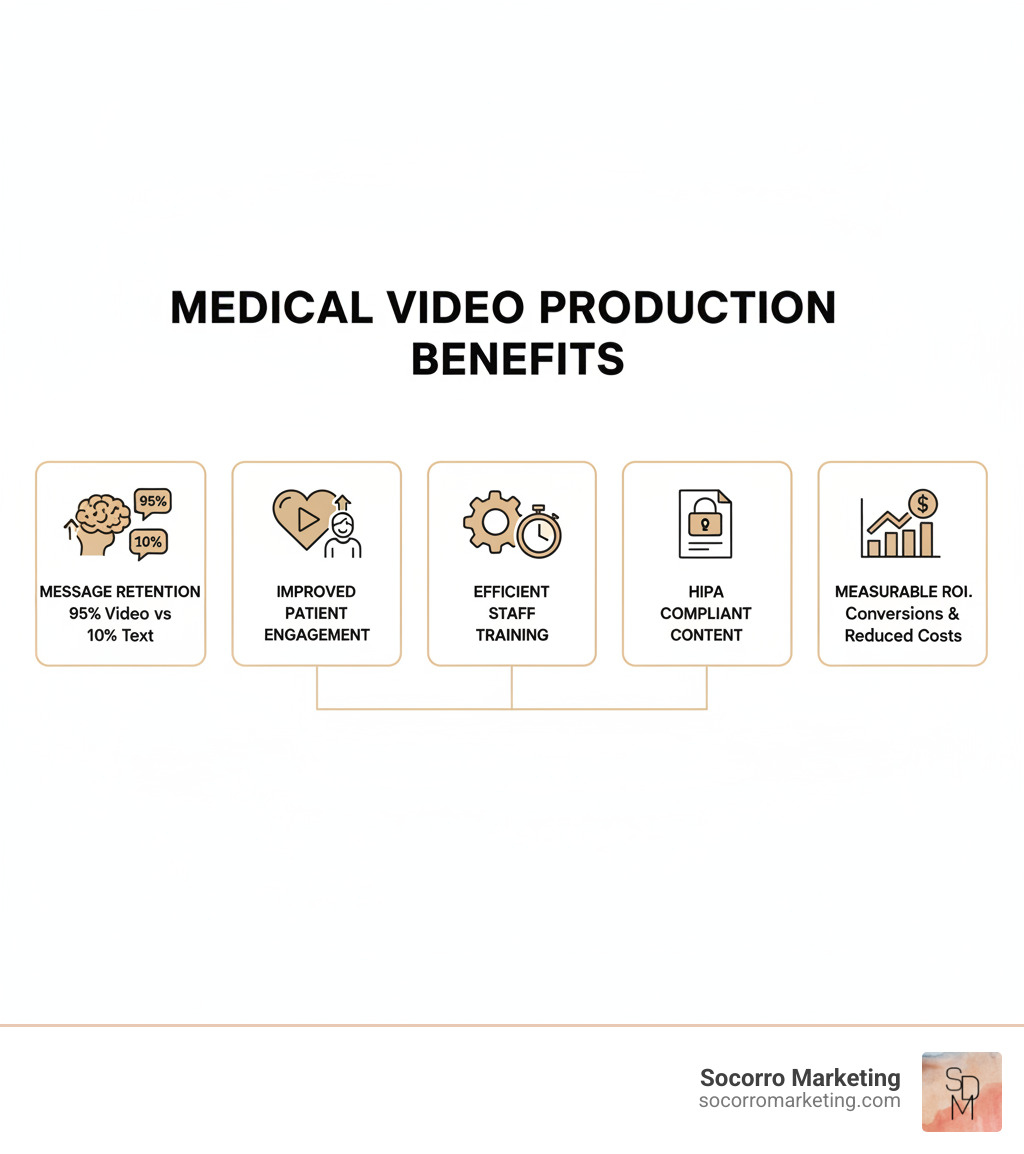
Key Benefits of Medical Video:
The healthcare industry struggles to explain complex medical concepts. Traditional text-based content often fails to help patients grasp treatment plans or train staff on new procedures. Video solves this by combining visuals, audio, and storytelling to make technical information accessible. However, healthcare video production requires specialized knowledge of medical accuracy, HIPAA regulations, and clinical communication.
Choosing the right partner requires more than technical skill; it demands a team that understands the healthcare environment, compliance, and how to communicate with both professionals and patients. A poor choice can lead to ineffective videos, wasted budgets, or damaging medical inaccuracies.
I'm Grace Ascione, a registered nurse with an MBA who has spent over 15 years helping healthcare businesses improve their digital presence. My clinical background provides unique insight into creating effective medical video production for patient education and professional training. This guide will walk you through what to look for in a video production partner and highlight top agencies in the healthcare industry.
If you've ever tried to explain a complex medical condition with words alone, you know the struggle. Patients may nod, but confusion often remains. Medical video production changes this dynamic entirely.
Consider this: people retain 95% of a message from video, compared to just 10% from text. This difference is critical when explaining how diabetes affects the body or what to expect during a procedure. Video simplifies complex medical concepts, making them clear and memorable. When patients understand their treatment plans and post-op instructions, they are more likely to follow through, leading to better health outcomes.
Beyond clarity, video builds genuine trust. A heartfelt patient testimonial or a physician compassionately explaining their approach to care humanizes your practice in a way text cannot. A virtual tour can ease a new patient's anxiety, while an interview with your staff showcases their expertise and warmth. This emotional connection directly impacts your bottom line.
Video content drives measurable results. For example, the American Society of Gene & Cell Therapy (ASGCT) saw a 52% growth in engaged site users in the first month of their explainer video series. This level of engagement translates to more appointment bookings and stronger patient loyalty. Video also boosts your website's search rankings and improves conversion rates, encouraging visitors to contact your practice.
Let's not forget your team. The U.S. healthcare training market is worth over $10 billion, as proper training is critical but resource-intensive. Video transforms this challenge. Standardized training modules allow new hires to learn on-demand, nurses to review complex procedures, and the entire team to receive consistent training without pulling senior staff from patient care. This efficiency is invaluable, especially for small healthcare facilities.
Incorporating video into a comprehensive content strategy can transform a practice's ability to serve its community. To learn more about how different content types work together, check out our article on How Content Marketing Can Benefit Your Small Business Healthcare Facility.
Video is a fundamental shift in how healthcare organizations communicate, educate, and connect. In an industry where trust and clarity are paramount, that shift is essential.
Just as a medical toolkit has different instruments for different needs, medical video production offers various formats depending on your goals, audience, and message.

Patient education videos help patients understand their conditions, treatments, and procedures, empowering them to participate in their own care.
Patient testimonials build trust by having real people share their genuine experiences, providing powerful social proof.
Staff training and onboarding videos standardize learning for new equipment, procedures, and compliance protocols, ensuring consistency and quality care.
Surgical procedure videos serve as invaluable educational tools for medical professionals and can be edited to explain operations to patients, reducing their anxiety.
Explainer videos using 2D or 3D animation are essential for visualizing concepts invisible to the naked eye, such as how medications work or how diseases progress.
Marketing and promotional content highlights your services and introduces your team, communicating why patients should choose your practice.
Facility tours give prospective patients a virtual walk-through, helping them feel comfortable before their first visit.
Physician interviews put a human face on your expertise, allowing doctors to build authority and a personal connection with viewers.
Public Service Announcements (PSAs) raise community awareness about public health issues, such as disease prevention or vaccination campaigns.
Each of these formats can play a strategic role in your overall Digital Marketing approach, helping you reach different audiences with custom messages.
Effective medical video production is a multi-step process requiring technical skill and an understanding of healthcare communication. When done right, the result is content that educates, engages, and meets the strict standards of the healthcare industry.
The process begins with scripting and storyboarding, which serves as the blueprint for the video. A well-crafted script ensures the message is clear and concise, while the storyboard maps out each scene visually. This planning phase saves time and prevents costly reshoots. Quality professional equipment, including 4K cameras, clear audio recorders, and proper lighting, is crucial for credibility. Poor technical quality can undermine your message before it's even delivered.
In post-production editing, raw footage is transformed into a polished story. Editors weave together the best takes, add music and voice-overs, and ensure a natural flow. Motion graphics like animated text and logos help highlight key information and add a professional finish. However, what truly sets healthcare video apart is the non-negotiable need for medical accuracy and compliance.
The U.S. healthcare professional training market is worth over $10 billion, growing at 4.3% annually, reflecting the demand for professional educational content that video delivers so effectively. An industry analysis on the healthcare training market confirms this trend.
In healthcare, misinformation can have severe consequences. Accuracy and compliance are at the heart of quality medical video production.
When live-action isn't feasible, animation is a powerful tool. It can illustrate what a camera cannot capture, from cellular processes to the internal workings of a medical device.
Mechanism of Action (MOA) videos, for example, use animation to show how a new drug works at a molecular level. Animation can also visualize cellular processes like immune responses, changing abstract concepts into memorable visuals. For simplifying surgical procedures, animation offers a cleaner, less graphic explanation suitable for patient education.
Both 2D and 3D animation have their place. 2D is often more cost-effective and approachable, ideal for patient-facing explainers. 3D provides a more realistic, immersive experience, perfect for detailed anatomical models or showcasing medical devices. By making complex information visual and engaging, animation is key to achieving high message retention.
Video makes it manageable to keep staff trained on evolving technologies, procedures, and regulations. Video-based training integrates with e-learning platforms, offering flexibility for busy clinicians to access modules anytime.
On-demand procedure observation allows staff to watch techniques repeatedly until they feel confident, leading to better learning outcomes. Video also helps standardize training across departments and facilities, ensuring everyone receives the same clear information. This consistency is vital for patient safety and operational efficiency. Even dry topics like compliance and safety protocols become more memorable when demonstrated visually. Investing in quality training videos yields real returns in staff competency, reduced errors, and faster onboarding.
Finding the right partner for your medical video production can be challenging. You need a team that understands healthcare, speaks your language, and can translate complex medical topics into compelling visual stories.

This section reviews established agencies to help you understand the market landscape. As you explore these options, consider what matters most for your organization—be it animation expertise, strategic thinking, or deep healthcare industry knowledge.
Founded in 2011, Demo Duck has experience in the healthcare video space. They specialize in animated explainer videos that simplify complex topics for patients and staff. Their approach is strategic; they focus on communication goals first to craft creative content that delivers results. Their client roster includes major healthcare organizations like the American Society of Gene & Cell Therapy (ASGCT) and Blue Cross Blue Shield. Higher-end animated projects typically range from $18,000–$25,000, with live-action running $25,000–$45,000.
Motifmotion takes a medically-informed approach to healthcare animations, emphasizing accuracy, clarity, and engagement. This focus makes them well-suited for projects where technical precision is non-negotiable. Their services are broad, including staff training videos, patient explainers, and animations that visualize invisible biological processes. They excel at making complex topics accessible without sacrificing scientific accuracy.
Sequence Health combines deep clinical insight with full-service production capabilities. They offer an end-to-end solution, managing projects from pre-production to final editing. Their specialty is patient journey videos and lead generation content, making them a strong choice for practices focused on patient acquisition. Their team believes that effective healthcare video requires a fundamental understanding of the clinical context, patient concerns, and healthcare decision-making processes.
Choosing a medical video production partner is a critical decision. Before committing your budget, conduct a thorough consultation to ensure you're making the right choice.
First, ask to see their portfolio of healthcare projects. A strong portfolio in the healthcare sector shows they understand the field's unique challenges. Next, inquire about their healthcare industry experience. Do they understand HIPAA, medical accuracy, and compliance standards? A team unfamiliar with these regulations can be a liability.
Discuss how they tailor content for different target audiences, from patients needing simple explanations to medical professionals requiring technical detail. Finally, clarify their communication and collaboration process. The best partnerships involve regular check-ins and a collaborative spirit. You should feel like they are working with you.
Clarifying your goals beforehand will streamline this process. Our guide on Defining Your Message and Brand with Medical Content Marketing can help you prepare.
Costs for medical video production vary dramatically. The project scope and complexity are the biggest drivers. Key factors include:
Production timelines typically run 8 to 12 weeks. Be upfront about your budget. A good partner will work within your constraints to deliver impact. Always request a detailed estimate that breaks down all costs, from scripting to final delivery, so you can make informed decisions.
For organizations needing a steady stream of content, a subscription-based video service is an alternative to project-by-project work. This model offers several advantages:
This model is not for everyone. If you only need one or two videos a year, a project-based approach is likely better. But for those committed to video as a core strategy, a subscription can provide a predictable budget and an efficient workflow.

Throughout this guide, we've seen how medical video production transforms healthcare communication. With a 95% message retention rate, video is essential for building patient trust, simplifying complex topics, and streamlining staff training. Strategic video delivers measurable results, as proven by organizations like ASGCT that saw 52% growth in engaged users.
However, creating effective healthcare video requires more than production skill. It demands a partner who understands clinical nuances, HIPAA compliance, and how to translate medical concepts for your specific audience.
This is where Socorro Marketing stands apart. We are a nurse-managed marketing team with genuine clinical insight. We view your video strategy through the lens of healthcare professionals who understand patient concerns, clinical workflows, and the regulatory landscape. Our team combines this clinical expertise with data-driven marketing strategies to ensure your videos achieve your specific goals.
Whether you're a small practice in Golden, CO, or a behavioral health facility in Utah, Arizona, or New Mexico, we tailor our approach to your community's needs. We know your organization is more than a business; it's a place of care and hope. Your communication should reflect that.
If you're ready to create videos that are medically accurate, engaging, and strategically designed to grow your practice, let's start a conversation. We'd love to show you how our unique blend of clinical knowledge and marketing expertise can help you thrive. You can also Explore our Behavioral Health Digital Marketing services to see how our specialized approach can help your message resonate.

