Health and wellness SEO is the specialized practice of optimizing medical and wellness websites to rank higher in search engines while meeting strict quality and trust standards. With roughly 1 billion health-related searches happening on Google dailyabout 7% of all searchesyour potential patients are actively looking for the services you provide.
What makes health and wellness SEO different:
The stakes are high because organic search results get a 34.2% click-through rate compared to just 1.91% for paid ads. This means ranking well organically brings significantly more patients to your practice than expensive advertising.
Small healthcare practices often struggle with generic marketing agencies that don't understand medical compliance requirements or patient search behavior. Generic SEO tactics can actually hurt medical websites if they don't account for Google's strict health content guidelines.
I'm Grace Ascione, a registered nurse with an MBA who has spent over 15 years helping healthcare businesses improve their digital presence and patient acquisition. My clinical background combined with Google Analytics and SEO certifications gives me a unique perspective on health and wellness SEO that bridges the gap between medical expertise and digital marketing success.
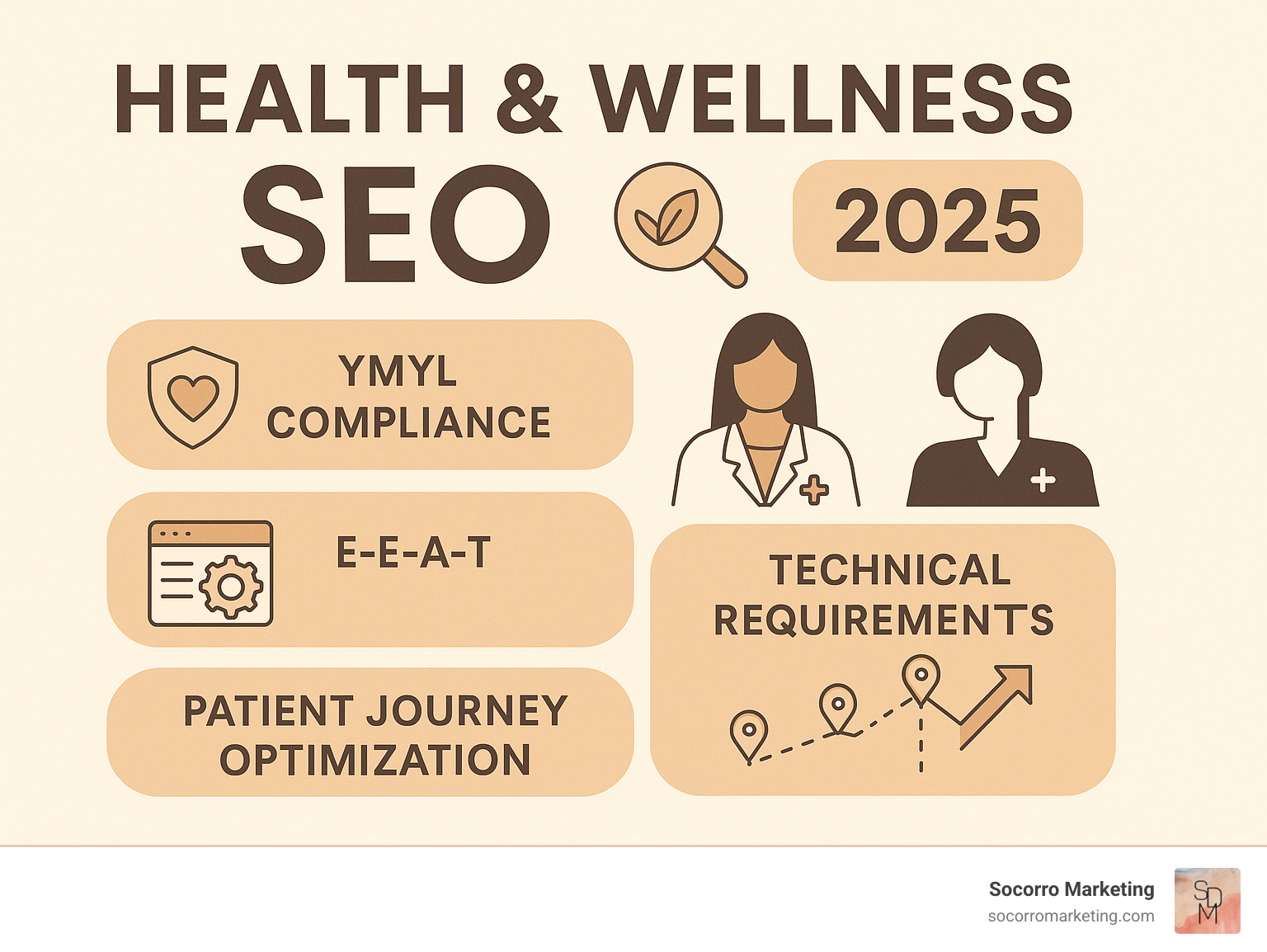
Health and wellness SEO isn't your typical digital marketing challenge. When someone searches for "chest pain symptoms" or "best pediatrician near me," they're not just browsingthey're making decisions that could affect their health and wellbeing. That's why Google treats health content differently than reviews for the latest smartphone.
The foundation starts with understanding YMYLYour Money or Your Life guidelines. Google created these standards because bad health information can literally harm people. When you're competing for rankings in the health space, you're being measured against the highest content standards on the internet.
This is where E-E-A-T becomes crucial. Experience, Expertise, Authoritativeness, and Trustworthiness aren't just buzzwordsthey're your roadmap to success. Google added that first "E" for Experience in 2022, recognizing that a nurse who's worked in pediatrics for 10 years might have more valuable insights than someone who just read about childhood development online.
The landscape shifted dramatically with major algorithm updates. The Medic Update in 2018 was a wake-up call41.5% of affected sites were healthcare-related. Then came BERT in 2020, which changed how Google understands natural language in about 1 in 10 searches. The ongoing Helpful Content Updates keep raising the bar, rewarding authentic, experience-based content over generic, AI-generated text.
Over 20,000 health and wellness businesses are competing for attention, and Google releases around 50 major algorithm updates every year. Staying current isn't just good practiceit's essential for survival.
| Traffic Source | Click-Through Rate | Cost | Sustainability |
|---|---|---|---|
| Organic Search (#1 Position) | 34.2% | Free after initial investment | Long-term |
| Paid Search Ads | 1.91% | Ongoing ad spend | Stops when budget ends |
| Social Media | Varies widely | Time + ad spend | Platform-dependent |
The BERT update was a game-changer for healthcare searches. Before BERT, if someone searched "can you get medicine for someone pharmacy," Google might show generic prescription information. After BERT, Google understands the nuance and shows results specifically about picking up prescriptions for family members.
This neural network approach means Google now gets the subtleties that matter in healthcare. It understands prepositional phrases that completely change meaning, conversational queries that patients actually use, and the important differences between similar medical conditions.
The Helpful Content Update emphasized that content must come from people with genuine experience, not just theoretical knowledge. This is exactly why having licensed healthcare professionals create or review your content isn't just nice to haveit's crucial for ranking success.
Consumer trust in search engines remains at 63%higher than traditional media, owned media, or social media. This trust translates directly into patient acquisition when you rank well for the right terms.
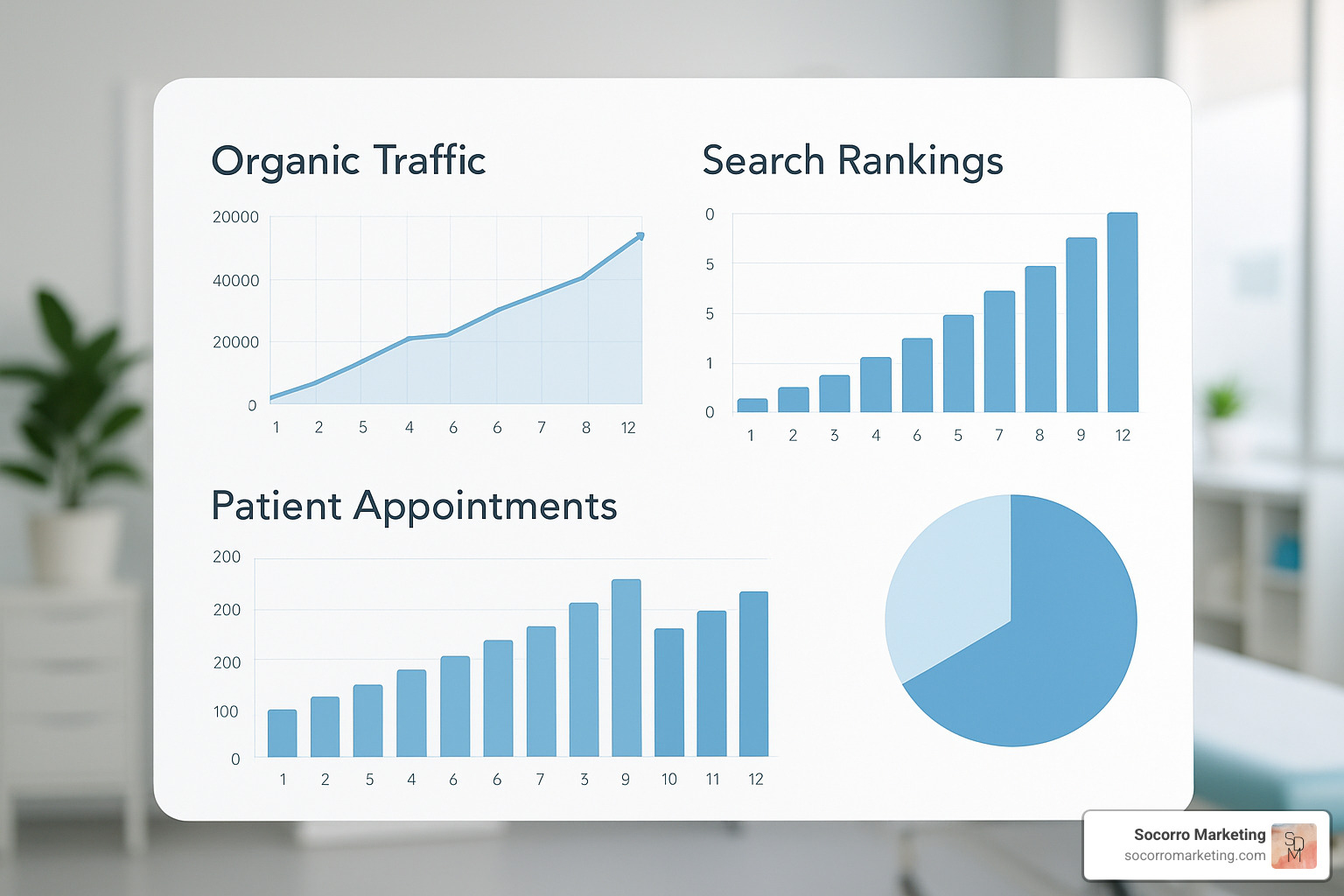
The numbers tell a compelling story about why health and wellness SEO delivers the best ROI for healthcare practices. That 34.2% click-through rate for the #1 organic position means more patients finding your practice without the ongoing costs of advertising.
83% of patients start with search engines when they have a health concern. They're not flipping through phone booksthey're typing their symptoms into Google at 2 AM when they can't sleep.
The typical patient journey: they recognize a problem, search for information online, evaluate their options (including reading reviews), and then take action. 76% read reviews before deciding, and the average person reads seven reviews before trusting a business.
What's powerful about organic search is the compound effect on brand credibility. When patients consistently see your practice ranking for their health concerns, it builds trust even before they visit your website.
Understanding search intent is crucial for healthcare keywords. High-volume head terms like "wellness" get 673,000 monthly searches, while "wellbeing" sees 246,000 searches. But these massive volume keywords are extremely competitive and often too broad to convert well.
Mid-tail terms with local intent tell a different story. "Wellness center near me" gets 33,100 monthly searches, and "health and wellness" sees 40,500. These searchers are getting more specific about what they want.
The real goldmine is in long-tail conversion terms like "wellness clinic near me," "best dietitian in [city]," or "massage therapy for stress relief." These have lower search volume but much higher conversion rates because they capture patients who are ready to book appointments.
For detailed strategies on finding and targeting the right keywords for your practice, check out our guide on SEO Strategy and Keyword Research.
Successful health and wellness SEO is like a three-legged stool. Remove any one leg and the whole thing topples over. Your three legs are on-page optimization, technical excellence, and local search dominance.
Your content is where the magic happens, but it needs to be the right kind of magic. Google's gotten really good at spotting the difference between someone who actually knows what they're talking about and someone who just copied information from WebMD.
Author credentials matter more than ever. Every piece of health content needs a detailed author bio that shows off your expertise. Include your professional licenses, years of experience, and any special training you've completed. Don't be shy about mentioning your hospital affiliations or professional memberships either.
Comprehensive content performs better, with research showing that articles between 2,000 and 2,500 words tend to rank higher. But length alone won't cut it. Your content needs to genuinely help patients and be medically accurate.
Meta tags are your first impression in search results. Your title tag should include your main keyword naturally, plus your location if you're targeting local patients. Keep your meta descriptions between 155-160 characters and include a clear call-to-action.
Every image needs descriptive alt text that serves both accessibility and SEO purposes. Instead of naming your image "doctor.jpg," try something like "Dr. Smith examining patient's knee for arthritis symptoms."
Write like you're talking to a friend, not giving a medical lecture. Use short paragraphs, bullet points for easy scanning, and proper heading structure. Make sure your text has good color contrast so everyone can read it easily.
Technical SEO is like the foundation of your house—nobody sees it, but everything depends on it working properly. If your website doesn't load quickly or breaks on mobile devices, even the most brilliant content won't help you rank.
Site speed is crucial because Google rewards sites that load in under two seconds. With over 60% of health searches happening on mobile devices, a slow site literally drives patients away. Compress your images, clean up your code, and invest in reliable hosting.
Core Web Vitals measure real user experience, and Google pays attention to these metrics. Your Largest Contentful Paint should happen within 2.5 seconds, your First Input Delay should be less than 100 milliseconds, and your Cumulative Layout Shift should be less than 0.1.
Mobile-first indexing means Google primarily looks at your mobile site when deciding how to rank you. Make sure your mobile site has all the same content as your desktop version, loads quickly, and has easy navigation with thumb-friendly buttons.
Schema markup helps Google understand your content by providing structured data. For healthcare practices, implement MedicalOrganization schema for your practice information, Review schema to display star ratings in search results, and FAQ schema for common patient questions.
HTTPS security isn't optional for healthcare websites. About 95% of websites use HTTPS encryption, and for healthcare sites that might handle patient information, this is both an SEO factor and a trust requirement.
Local SEO is absolutely critical for healthcare practices because 46% of all Google searches have local intent. When someone searches for "chiropractor near me" or "family doctor," they're ready to make an appointment—you just need to be found.
Your Google Business Profile is your digital storefront. Complete every section with accurate information, add high-quality photos of your facility and staff, and post weekly updates about your services or helpful health tips. Respond to all reviews within three business days—this shows both Google and potential patients that you're actively engaged.
NAP consistency (Name, Address, Phone number) must be identical across all online directories. Even small differences like "St." versus "Street" can confuse Google and hurt your local rankings.
Review management deserves its own strategy. Encourage satisfied patients to leave reviews, but do it naturally—maybe include a gentle reminder in your follow-up emails. When you get negative reviews, respond professionally and use them as opportunities to showcase your commitment to patient care.
Local content creation helps you connect with your community while improving your SEO. Write about topics that incorporate your location naturally, like "Managing seasonal allergies in Colorado Springs" or "Nutrition tips for high-altitude living in Denver."
For more strategies on boosting your organic visibility, check out our guide on How to Increase Organic Search Traffic.
The future of health and wellness SEO lies in embracing emerging technologies while maintaining the human touch that patients value. Artificial intelligence, voice search, and advanced analytics are reshaping how patients find healthcare providers.
Generative AI has revolutionized healthcare SEO by providing data-driven insights and automating time-consuming tasks. However, it's crucial to use AI as a tool to improve human expertise, not replace it.
AI-Powered Content Strategy:
Schema Markup Automation: AI tools like ChatGPT can generate structured data markup for your healthcare content. You can prompt AI to create MedicalOrganization schema that includes your practice details, accepted insurance, and specialties.
Compliance Checks: AI can help identify potential HIPAA violations or medical accuracy issues in your content before publication, though human review remains essential.
Voice search is changing how patients find healthcare information. People speak differently than they type, using more conversational, natural language queries.
Voice Search Optimization Strategies:
Visual Search Preparation: As image recognition improves, optimize your visual content:
Building authority in healthcare requires a multi-faceted approach that demonstrates expertise, earns trust, and establishes your practice as a go-to resource.
Strategic Backlink Building:
Review Strategy Beyond Google:
For healthcare practices, implementing proper MedicalOrganization schema guidelines helps search engines understand your services, location, and credentials.
Successful health and wellness SEO requires continuous monitoring and adjustment. The healthcare landscape changes rapidly, and your SEO strategy must evolve accordingly.
Essential Analytics Setup:
Key Performance Indicators (KPIs):
Compliance Monitoring:
Continuous Improvement Process:
Health and wellness SEO is like performing surgery compared to fixing a leaky faucet—the stakes are infinitely higher, and precision matters. While a generic e-commerce site might get away with basic optimization, healthcare websites face Google's strictest scrutiny under YMYL (Your Money or Your Life) guidelines.
The difference starts with E-E-A-T compliance—every piece of content must demonstrate genuine Experience, Expertise, Authoritativeness, and Trustworthiness. This isn't just about keywords; it's about proving you're qualified to give medical advice. Your content needs detailed author bios showing professional licenses, years of experience, and ongoing education.
Medical accuracy is non-negotiable. Generic SEO might tolerate some creative liberties with facts, but healthcare content must be medically sound and regularly updated. What was considered best practice five years ago might be outdated today.
Regulatory compliance adds another layer of complexity. Your website must follow HIPAA privacy rules, FDA guidelines for medical claims, and accessibility standards. Generic websites don't face these requirements, but healthcare sites that ignore them risk serious legal consequences.
Think of it this way: a poorly optimized retail website might lose some sales, but a poorly optimized medical website could prevent someone from getting life-saving treatment. That's why Google treats health content with such scrutiny.
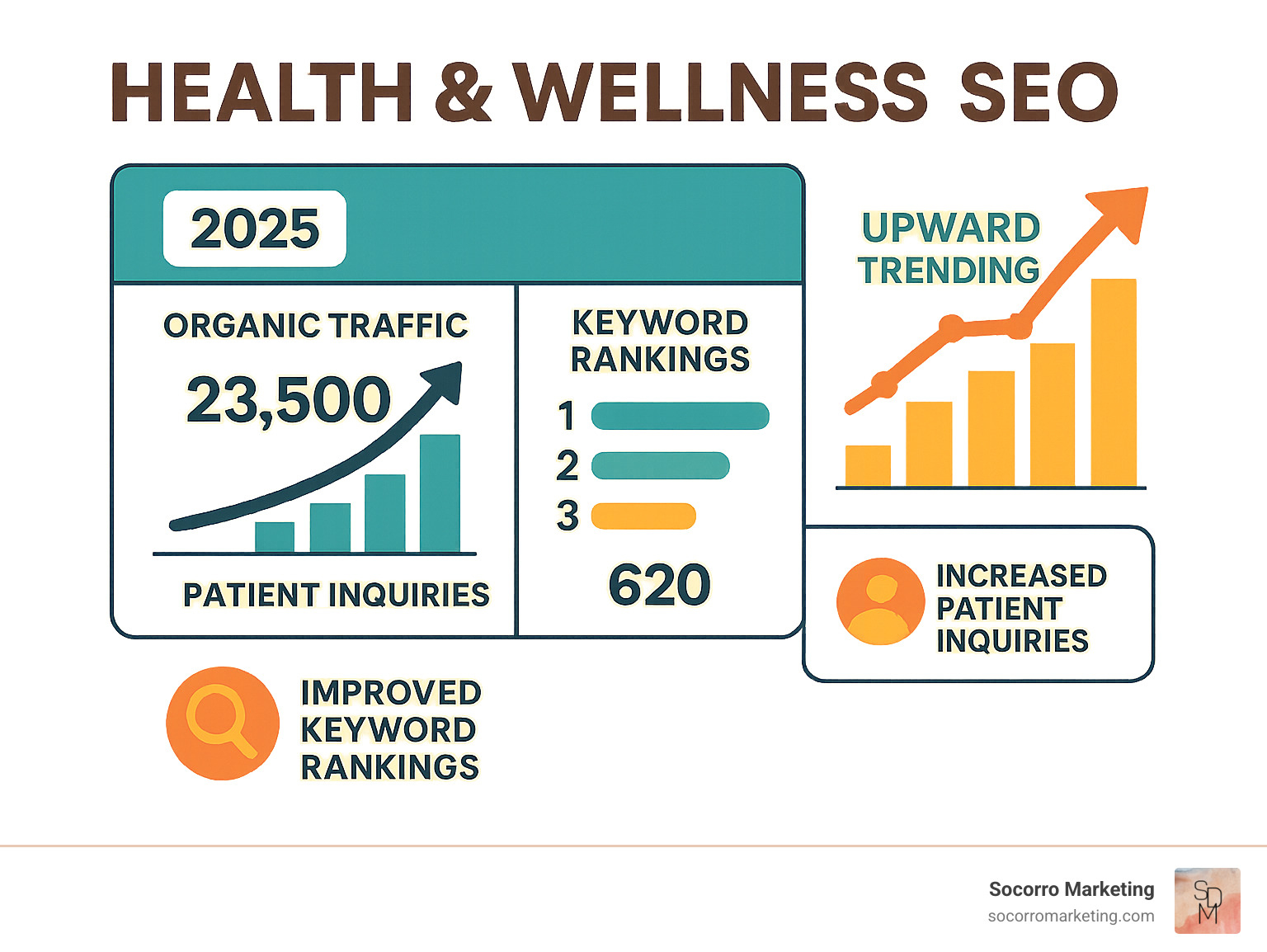
I wish I could tell you that health and wellness SEO works overnight, but that would be like promising instant weight loss—tempting but unrealistic. Healthcare SEO typically takes three to six months to show initial results, with significant improvements often taking six to twelve months.
The first three months are all about foundation building. We're fixing technical issues, creating quality content, optimizing your Google Business Profile, and establishing those crucial trust signals. It's like preparing soil before planting—not glamorous, but essential.
Months four through six bring the first green shoots of success. You'll start seeing improved local search visibility, increased organic traffic for specific health conditions you treat, and better performance from your Google Business Profile.
Months seven through twelve are where the real magic happens. Your rankings for competitive keywords improve, patient inquiries increase noticeably, and your practice establishes itself as a trusted authority in your field.
The timeline depends on several factors. Competition level matters enormously—if you're a dermatologist in Manhattan, expect a longer timeline than if you're a family doctor in a smaller town. Your starting point also matters; newer practices need more time to build authority than established ones.
What you can control is content quality and consistency. High-quality, expert content accelerates results, while regular optimization efforts compound over time. Think of SEO as a long-term investment in your practice's future—while paid advertising stops working when you stop paying, good SEO continues driving patients to your practice for years.
This question makes me smile because it's like asking if small restaurants need good food—technically optional, but practically essential for survival. Small local clinics often benefit more from health and wellness SEO than large hospital systems.
Local search is your secret weapon. Nearly half of all Google searches have local intent, and "near me" searches have exploded by 150% in recent years. While big hospitals compete nationally, you can dominate your local market. When someone in your town searches for "family doctor near me" or "urgent care open now," you want to be the first result they see.
The economics make perfect sense too. Organic search delivers a 34.2% click-through rate compared to just 1.91% for paid ads. For small practices operating on tight budgets, SEO provides better ROI than expensive advertising campaigns.
Trust building happens naturally when you rank well. About 63% of consumers trust search engines more than other media when researching businesses. When you consistently appear at the top of search results, it builds credibility even before patients visit your website.
Here's the beautiful part: many small practices neglect SEO, creating golden opportunities for those who invest in it. You can outrank larger competitors by focusing on local, long-tail keywords and creating genuinely helpful content for your community.
The patient behavior data is crystal clear—three in four people search online for doctors and healthcare providers. If you're not visible in search results, you're essentially invisible to potential patients.
I've seen this work firsthand. A small family practice we helped in Golden, Colorado, saw a 300% increase in new patient inquiries within six months. They focused on local optimization, created helpful health content for their community, and consistently managed their online reputation.
The key is playing to your strengths as a small practice. You can be more personal, more responsive, and more connected to your local community than big hospital systems. Health and wellness SEO amplifies these advantages, helping you reach patients who are actively looking for exactly what you provide.
Success in health and wellness SEO isn't just about climbing search rankings—it's about being there when someone needs your help most. Picture this: it's 2 AM, and someone can't sleep because they're worried about chest pain. They grab their phone and search for "heart palpitations anxiety or serious." If you've done your SEO right, your helpful, expert content appears when they need reassurance most.
That's the real power of healthcare SEO. With over 1 billion health searches happening daily, you're not just marketing—you're providing a lifeline to people seeking answers about their health.
The game has changed dramatically since Google introduced YMYL guidelines and E-E-A-T requirements. The days of generic health content are over. Google now rewards practices that demonstrate genuine medical expertise and provide real value to patients. The BERT and Helpful Content updates have made it clear: authenticity wins over optimization tricks.
Organic search results get clicked 34.2% of the time, while paid ads only get 1.91%. That means every dollar you invest in SEO works harder and lasts longer than advertising spend. When you stop paying for ads, the traffic stops. When you build solid SEO, it keeps bringing patients to your door for years.
Your path forward starts with understanding where you are now. Audit your current website to see how it measures up against Google's standards. Then create content that genuinely helps patients—not just content stuffed with keywords. 46% of searches have local intent, so dominate your local market by optimizing your Google Business Profile and building genuine community connections.
The future belongs to practices that accept new technologies while maintaining the human touch. AI tools can help you work smarter, but they can't replace your clinical expertise. Voice search is changing how patients find you, so make sure your content sounds natural when spoken aloud.
At Socorro Marketing, we've seen the change that happens when healthcare practices get their SEO right. Our nurse-managed approach means we understand both the clinical side and the marketing side of healthcare. We've helped practices across Colorado, Utah, Arizona, and New Mexico turn their websites into patient magnets.
Whether you're a solo practitioner in Golden, CO, or running a growing wellness center in Phoenix, the principles remain the same: provide exceptional care, share your expertise online, and make it easy for patients to find you. The practices that thrive in today's digital world are those that understand patients don't just need treatment—they need education, reassurance, and trust.
Ready to transform how patients find your practice? Our comprehensive Digital Marketing approach combines clinical insight with proven SEO strategies. We know healthcare because we've lived it, and we know marketing because we've mastered it.
The future of healthcare is digital, but it's still deeply human. Patients are searching for providers who understand both medicine and modern communication. By implementing these health and wellness SEO strategies, you'll not only improve your search rankings—you'll build the trust and authority that turn worried late-night searchers into loyal patients who trust you with their health.
Your expertise can change lives. Now it's time to make sure people can find it.

